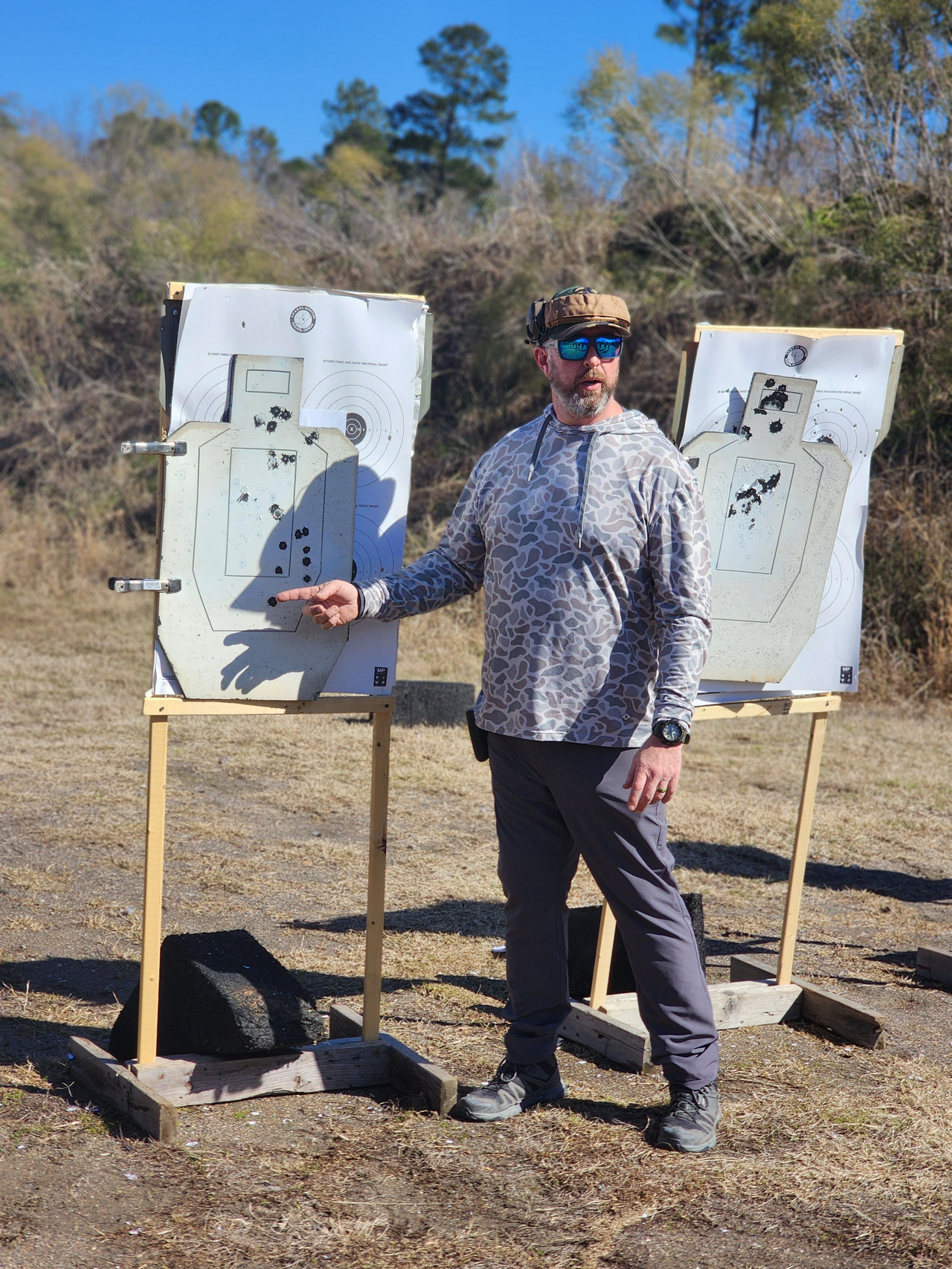
Coaching Vs. Instructing
Coaching vs. Instructing: Understanding the Difference and Why Both Matter in Firearms Training
Carolina Tactical Training | Plan with Purpose. Prepare with Confidence. Perform with Excellence.
When it comes to firearms training, one of the most common questions we hear is, "What kind of training do I need?"
It's a great question, and the answer isn't always as simple as signing up for the next available class.
At Carolina Tactical Training (CTT), we believe that becoming a safe, confident, and proficient firearm owner is a journey. Whether you're purchasing your first handgun, preparing for your concealed weapons permit, or looking to sharpen the skills you've developed over years of shooting, there is always an opportunity to learn and improve.
But here's something that often gets overlooked:There is a difference between receiving instruction and receiving coaching.
Both are incredibly valuable. Both play an important role in developing your abilities. And while they share many similarities, understanding their differences can help you make better decisions about your training.
Let's explore what makes each approach unique, when you might benefit from one over the other, and why combining the two can make a tremendous difference in your development as a responsible firearm owner.
What Is Firearms Instruction?
Think back to the first time you learned something completely new.
Maybe it was driving a car, playing a musical instrument, or learning to swim. Before you could develop your abilities, someone had to introduce you to the fundamentals.
They explained how things worked, demonstrated proper techniques, and provided the knowledge necessary for you to begin practicing safely and effectively.
That is the foundation of instruction.
Firearms instruction is the structured process of teaching knowledge, techniques, and skills through an organized learning experience.
A qualified firearms instructor introduces students to new concepts, demonstrates proper techniques, explains the reasoning behind those techniques, and provides opportunities for students to practice what they have learned.
Instruction typically follows a defined curriculum with specific learning objectives.
For example, in our Handgun Foundations course at Carolina Tactical Training, students learn essential information about firearm safety, handgun operation, ammunition, and the fundamentals of marksmanship.
The instructor's responsibility is to ensure that students understand these concepts and can begin applying them safely and correctly.
Instruction provides the foundation upon which future skills are built.
What Does a Good Instructor Do?
A professional firearms instructor does much more than stand in front of a classroom and deliver information.
An effective instructor creates an environment where students feel comfortable asking questions, making mistakes, and learning new skills.
The instructor must communicate information clearly, demonstrate proper techniques, recognize when students are struggling, and adapt their teaching methods to accommodate different learning styles.
Most importantly, an instructor maintains a safe and productive learning environment.
Consider a student who has never handled a handgun before.
The instructor begins by explaining the universal firearm safety rules, identifying the components of the handgun, demonstrating safe handling procedures, and introducing the fundamentals of marksmanship.
The student receives structured instruction and opportunities to practice under supervision.
By the end of the course, the student should have a better understanding of how to safely handle the firearm and begin developing the skills necessary for responsible ownership.
Instruction teaches you what you need to know, why it matters, and how to begin doing it correctly.
But what happens after you have learned the fundamentals?
That's where coaching becomes particularly valuable.
What Is Firearms Coaching?
Imagine that you've completed your concealed weapons permit course, attended several training classes, and spent time practicing at the range.
You understand firearm safety. You know the fundamentals of marksmanship. You can explain proper grip, stance, sight alignment, and trigger control.
Yet something isn't quite right.
Perhaps your shot placement is inconsistent. Maybe you're struggling to maintain your grip during recoil. Or perhaps you've reached a point where your performance has stopped improving, despite spending more time at the range.
You know what you're supposed to do, but you're having difficulty consistently putting that knowledge into practice.
This is where coaching can make a significant difference.
Firearms coaching is a personalized process focused on evaluating, refining, and developing an individual's existing skills to improve performance and achieve specific goals.
While instruction typically focuses on teaching a defined body of knowledge or introducing new skills, coaching focuses on the individual and their performance.
A coach observes how you apply what you've learned, identifies opportunities for improvement, provides specific feedback, and helps you develop a plan to move forward.
Coaching is not simply telling someone what they're doing wrong.
It's helping them understand what is happening, why it is happening, and how they can make meaningful improvements.
What Does a Good Coach Do?
A professional firearms coach begins by understanding the individual.
What are your goals? What challenges are you experiencing? What skills have you already developed? What do you want to accomplish?
Once those questions are answered, the coach can begin evaluating your current performance.
For example, suppose a student consistently places their shots to one side of the intended target.
Rather than simply telling the student to aim differently, a coach evaluates the student's technique to identify potential contributing factors.
Is the student maintaining a consistent grip? Is their trigger control affecting the movement of the firearm? Are they anticipating recoil?
The coach observes, provides feedback, and helps the student make adjustments.
The process may involve repeated practice, additional evaluation, and modifications to the student's training plan.
Over time, the student develops a better understanding of their own performance and becomes more capable of recognizing and correcting mistakes independently.
Coaching helps you turn what you know into what you can consistently do.
And that distinction is important.
Instruction and Coaching: More Alike Than You Might Think
Although instruction and coaching serve different purposes, they share several important characteristics.
Both require professional knowledge, effective communication, patience, and a genuine commitment to helping students succeed.
A good instructor and a good coach must understand the subject matter they are teaching. They must also recognize that every student brings different experiences, abilities, and expectations to the training environment.
Both approaches require observation, feedback, encouragement, and a willingness to adapt.
Most importantly, both must prioritize safety.
At Carolina Tactical Training, we believe that safety is not simply a topic covered at the beginning of a class. It is a fundamental responsibility that remains present throughout every training experience.
Whether an instructor is introducing a new student to firearm handling or a coach is working with an experienced shooter to improve performance, the responsibility to maintain a safe learning environment never changes.
There is another important similarity.
Both instruction and coaching should help students become more confident, competent, and independent.
The goal should never be to make students dependent on an instructor or coach for every decision.
Instead, the objective is to develop individuals who understand their abilities, recognize their limitations, and take responsibility for their continued development.
The Key Differences Between Instruction and Coaching
One of the easiest ways to understand the difference is to consider the primary focus of each approach.
Instruction generally focuses on teaching a particular subject or skill.
Coaching generally focuses on developing the individual who is applying that skill.
Here's a closer look at how the two approaches compare.
Firearms Instruction | Firearms Coaching |
|---|---|
Focuses on teaching knowledge and introducing skills. | Focuses on improving individual performance and refining existing skills. |
Typically follows an established curriculum. | Typically follows a personalized development plan. |
Emphasizes understanding concepts and learning proper techniques. | Emphasizes evaluating performance and making targeted improvements. |
Often takes place in a structured group-class environment. | Often takes place in an individual or small-group setting. |
Uses demonstrations, explanations, and guided practice. | Uses observation, feedback, corrective exercises, and performance evaluation. |
Measures progress against established learning objectives. | Measures progress against individual goals and performance benchmarks. |
Helps students develop foundational knowledge and abilities. | Helps students improve consistency, efficiency, and the application of their abilities. |
These differences are not absolute.
An instructor may provide individual coaching during a class, and a coach may introduce new information or techniques during a coaching session.
In fact, the most effective training experiences often incorporate elements of both.
The important distinction is understanding the primary purpose of the training experience you are choosing.
When Should You Choose Instruction?
If you're new to firearms, learning an unfamiliar skill, or seeking to develop a broader understanding of a particular subject, structured instruction is often an appropriate starting point.
Consider a new firearm owner who has never received formal training.
They may have purchased a handgun for personal protection but have limited experience handling or operating it.
Signing up for a structured handgun course provides an opportunity to learn essential safety principles, firearm operation, and foundational marksmanship skills in an organized environment.
Now consider someone who has owned handguns for several years but wants to begin learning about precision rifle shooting.
Although they have firearms experience, precision rifle shooting introduces new concepts, equipment considerations, and techniques.
A structured precision rifle course can provide the knowledge and foundational skills necessary to begin developing proficiency in that discipline.
Instruction is particularly valuable when you need to learn something new, establish a foundation, or expand your knowledge into an unfamiliar area.
The fact that you're experienced in one area doesn't mean you no longer need instruction in another.
Even highly experienced shooters benefit from learning new techniques, exploring different disciplines, and continuing their education.
There is always something new to learn.
When Should You Choose Coaching?
Coaching becomes particularly valuable when you have already developed foundational knowledge but want to improve specific aspects of your performance.
Perhaps you've attended several training courses but continue to struggle with consistency.
Maybe you're preparing for a shooting competition and want to improve your performance in a particular area.
Or perhaps you simply want someone to evaluate your current abilities and help you develop a more effective practice routine.
These are excellent reasons to consider individualized coaching.
For example, imagine a student who has completed several handgun courses and regularly practices at the range.
The student understands the fundamentals but notices that their accuracy deteriorates as they increase their shooting pace.
Rather than repeating an entire introductory course, the student may benefit from a coaching session focused on evaluating their technique and identifying the specific factors affecting their performance.
A coach can observe the student, provide targeted feedback, and help establish measurable goals for improvement.
The student can then incorporate that feedback into their regular practice sessions.
Coaching can also be valuable for individuals who have developed habits that are limiting their progress.
Sometimes, we become so accustomed to doing something a particular way that we don't recognize the adjustments we need to make.
An experienced coach provides an outside perspective that can help identify those opportunities.
If you understand what you're supposed to do but struggle to do it consistently, coaching may be exactly what you need.
A Real-World Example: Two Students, Two Different Needs
Let's imagine two students arriving at Carolina Tactical Training on the same Saturday morning.
Both want to become more proficient with their handguns.
Both are motivated, enthusiastic, and ready to learn.
However, their training needs are very different.
Student One: Building the Foundation
Our first student recently purchased their first handgun.
They have limited experience and want to learn how to handle their firearm safely, understand its operation, and develop the fundamentals of marksmanship.
This student would likely benefit from a structured Handgun Foundations course.
The instructor can introduce essential concepts, demonstrate proper techniques, and guide the student through a progressive learning experience.
The objective is to establish a solid foundation of knowledge and skills.
Student Two: Improving Existing Skills
Our second student has owned firearms for several years.
They have completed their concealed weapons permit course, attended additional training, and regularly practice at the range.
However, they have noticed that their performance has plateaued.
Despite practicing frequently, they continue to experience inconsistent shot placement and have difficulty identifying what needs to change.
This student may benefit more from an individualized coaching session.
A coach can evaluate their current technique, identify specific areas for improvement, and develop a focused practice plan.
Both students are working toward the same general objective: becoming safer, more confident, and more proficient firearm owners.
But their individual needs call for different training approaches.
Choosing the right training experience isn't about how long you've owned a firearm. It's about understanding where you are in your development and identifying what you need to move forward.
Why Taking More Classes Isn't Always the Answer
At Carolina Tactical Training, we strongly encourage continuing education.
We believe responsible firearm owners should make an ongoing commitment to developing and maintaining their abilities.
However, continuing education doesn't necessarily mean repeatedly taking classes without a clear purpose.
There is an important difference between acquiring additional knowledge and improving the application of knowledge you already possess.
Imagine attending a class where you learn several new techniques.
You leave the course excited, motivated, and eager to put those techniques into practice.
But over the following weeks, you return to the range and continue practicing the same way you always have.
Without meaningful feedback or a structured practice plan, you may struggle to incorporate what you learned into your regular performance.
You might decide that the solution is to attend another class.
And then another.
While additional instruction can certainly be valuable, there may come a point when the greater opportunity lies in developing the skills you've already been taught.
That's where coaching can help bridge the gap.
A coach can work with you to evaluate how well you're applying the concepts you've learned, identify areas that require additional attention, and develop a practice plan focused on measurable improvement.
The goal is not simply to accumulate training certificates.
The goal is to develop abilities that you can demonstrate consistently and responsibly.
The Missing Piece: Deliberate Practice
Whether you choose instruction, coaching, or a combination of both, there is one element that remains essential to your development.
Practice.
But not all practice is equally productive.
Simply going to the range and firing a large number of rounds doesn't automatically mean your skills are improving.
Productive practice requires a purpose.
It involves identifying what you want to improve, establishing a plan, evaluating your performance, and making adjustments based on the results.
This is often referred to as deliberate practice.
For example, if your goal is to improve your consistency with a handgun, your practice sessions should include specific exercises designed to develop and evaluate the skills that contribute to consistent performance.
Rather than simply shooting until you've exhausted your ammunition, you should be able to answer a few important questions.
What skill am I working on today? What does successful performance look like? How will I measure my progress? What adjustments should I make before my next practice session?
Instruction helps you understand the techniques and principles necessary to develop your abilities.
Coaching helps you identify how to improve your individual performance.
Deliberate practice gives you the opportunity to apply that knowledge and feedback consistently.
Together, these elements create a more purposeful approach to training.
The Best Training Path Often Includes Both
Here's something we want every Carolina Tactical Training student to understand:
You don't have to choose between instruction and coaching forever.
In fact, the two approaches complement one another.
Think of your training journey as a continuous cycle.
You attend a structured course to learn new information and develop foundational skills.
You practice those skills to improve your familiarity and consistency.
You participate in a coaching session to evaluate your performance and identify opportunities for improvement.
You return to practice with a clearer understanding of what you need to accomplish.
Eventually, you may attend another course to introduce new skills or expand your knowledge into a different area.
And the process continues.
Instruction provides the knowledge. Coaching helps refine the application. Practice develops consistency.
Each plays a meaningful role in your development.
There is no point at which a responsible firearm owner should assume that learning is complete.
Our abilities can change over time. Equipment changes. Techniques evolve. Personal goals shift.
Continuing education and regular evaluation help ensure that our training remains relevant to our individual needs.
How to Choose the Right Training Experience for You
Before registering for your next firearms course or scheduling a coaching session, take a few moments to evaluate your current needs.
Start by asking yourself what you want to accomplish.
Are you trying to learn something new, or are you trying to improve something you already know?
If you're unfamiliar with a particular subject or technique, structured instruction may provide the foundation you need.
If you already understand the fundamentals but are struggling with consistency or a specific performance challenge, individualized coaching may be more appropriate.
Next, consider how well you understand your current abilities.
Can you identify your strengths and weaknesses? Do you have measurable goals? Are you following a structured practice plan?
If you're unsure where to begin, a coaching session can help establish a clearer picture of your current performance and identify your next steps.
Finally, consider the type of learning environment that works best for you.
Some students thrive in a structured classroom or group-training environment where they can learn alongside others.
Other students benefit from personalized attention and the opportunity to focus on their individual challenges.
Neither preference is wrong.
The important thing is selecting a training experience that supports your goals, current abilities, and preferred learning style.
And remember,the right choice today may be different from the right choice six months from now.
Your training should evolve as you do.
Our Philosophy at Carolina Tactical Training
At Carolina Tactical Training, we believe that our responsibility extends beyond simply teaching students how to operate a firearm.
Our mission is to empower responsible citizens through education, training, and leadership—teaching every student to Plan with Purpose, Prepare with Confidence, and Perform with Excellence.
That philosophy influences how we approach both instruction and coaching.
We want our students to understand not only how to perform a particular skill, but also why that skill matters and how it fits into their broader personal preparedness goals.
We want them to recognize that proficiency is developed through continued education, purposeful practice, and a willingness to evaluate their own performance.
And we want them to enjoy the process!
Learning new skills should be rewarding. Seeing measurable improvement should be exciting. Overcoming a challenge that once seemed impossible should give you a genuine sense of accomplishment.
Whether you're attending your first handgun class or working with a coach to refine skills you've practiced for years, every meaningful step forward is worth celebrating.
Our instructors and coaches are here to help you take those steps.
Not by promising shortcuts or instant proficiency, but by providing professional guidance, constructive feedback, and a supportive training environment where you can continue to grow.
Your Next Step Starts With Understanding Your Needs
If there's one thing we hope you take away from this article, it's that instruction and coaching are not competing approaches to firearms training.
They are complementary tools that serve different purposes.
Instruction helps you acquire the knowledge and foundational skills necessary to begin your development.
Coaching helps you evaluate, refine, and improve how you apply those skills.
Both are important.
Both have their place.
And both can contribute to your long-term success as a responsible firearm owner.
The next time you consider signing up for a firearms class, ask yourself a simple question:
"Do I need to learn something new, or do I need help getting better at something I've already learned?"
Your answer can help you identify the training experience that will provide the greatest benefit for your current needs.
And if you're not sure, that's perfectly fine, too.
Sometimes, a conversation with a qualified instructor or coach is the first step toward developing a more effective training plan.
At Carolina Tactical Training, we're here to help you identify your goals, understand your options, and take the next step in your training journey.
Because responsible firearms training isn't about how many classes you've attended or how many rounds you've fired.
It's about developing the knowledge, judgment, and practical abilities necessary to handle your firearm safely, confidently, and responsibly.
And that is a journey worth investing in.
Ready to Take the Next Step in Your Training?
Whether you're looking to build a strong foundation through structured instruction or refine your existing abilities through personalized coaching, Carolina Tactical Training offers training opportunities designed to help you continue developing your skills.
Explore our firearms courses, learn more about private training, or contact us to discuss which training option may be appropriate for your individual goals.
Plan with Purpose. Prepare with Confidence. Perform with Excellence.
Carolina Tactical Training
Website:www.carolinatacticaltraining.com
Phone: 803-497-9225
Your training journey doesn't end when the class is over. It's just getting started.